
I am a slow reader. While most writers learn their craft by constantly devouring books, I plod along. Fortunately, I can watch movies as fast as anyone. While my reading habits have taken a hit at different times in my life, movie watching is a near constant. Movies have been one of the most influential storytelling teachers in my life.
Here are a handful of movies from the last 20 years that offer enlightening lessons for any storyteller. Warning: Here be spoilers.

GOOD TIME (2017) / UNCUT GEMS (2019)
The Safdie Brothers’ last two adrenaline pushers are equal parts exhilarating and stressful to watch. UNCUT GEMS in particular uses jarring cuts to subtly disorient the viewer. Both movies feature reprehensible main characters who tempt fate and fall inexorably into an abyss of their own making.
The main lesson writers can take from these movies is how to effectively craft a downward spiral narrative arc. There are few moments of reprieve from the main characters’ horrific downfalls. Their few pitiable moments are quickly squashed by the characters’ own bad decision-making. Indeed, that agency is central to making these awful characters’ stories intriguing. They are both surrounded by nasty people and rotten themselves. GOOD TIME relies on generating an iota of good faith for the MC in the opening scene. We learn his brother has a disability; the remainder of the spiral rides on his actions, which further deplete our sympathy. Likewise, By the end of UNCUT GEMS, Howard Ratner achieves what feels like redemption to him, but in truth is a catastrophe. There’s more pity in GEMS, because Ratner’s downslide is dictated by his gambling addiction.
These powerful narrative arcs are not tragedies; nor are they inversions of a redemptive arc. They are complete and forceful downward spirals. They are Horror stories based entirely on the characters’ own faults. They’re unrelenting and rich with moral implication. I don’t know if it would be very pleasant to read (or write!) a whole novel with this arc. However, I’ve found it satisfying to experiment with this arc in short stories.

ETERNAL SUNSHINE OF THE SPOTLESS MIND (2004)
This sci-fi romance/drama has been selected by many critics as the best movie of its decade. As a work of style and story it is commendable, brashly navigating the limits of human emotion, memory, and personal growth. Michel Gondry pairs his knack for homespun whimsy with the wise, understated delivery of powder keg performances.
Charlie Kaufman’s script is this movie’s backbone. His screenplay is the apex of the style of storytelling that critics adore nowadays—the complete synthesis of story, premise, and theme. * None of these elements outshine the others in ETERNAL SUNSHINE. They intertwine, supporting one another, and are delivered in a pronounced manner. Every dramatic choice is a thrust forward on every level; there is no chaff. And Kaufman pulls this off with a rather high premise, a complex plot, and some of the simplest themes of love and regret, to create an organic whole.
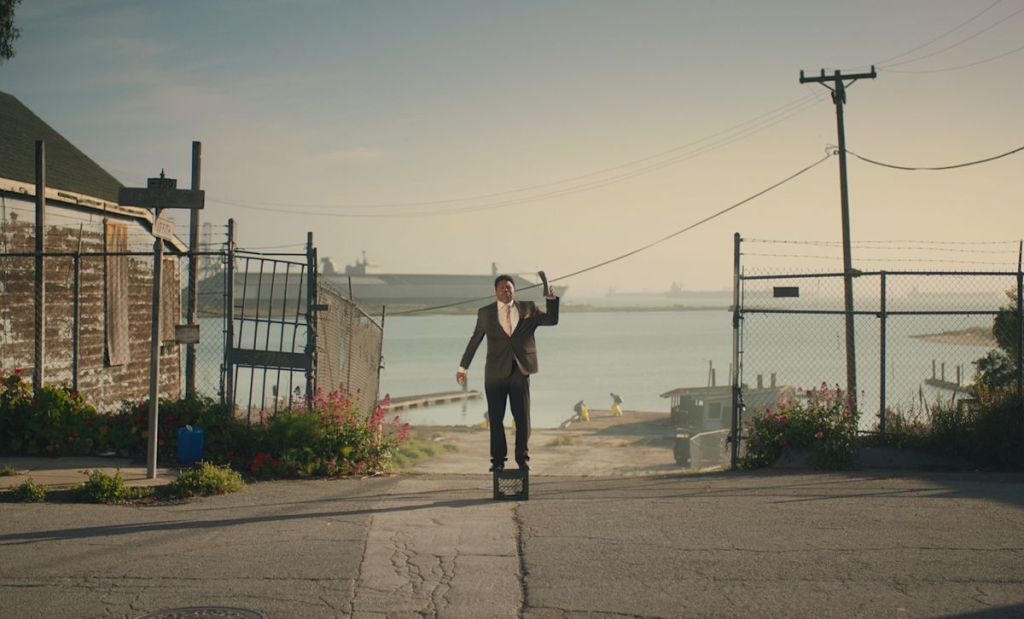
THE LAST BLACK MAN IN SAN FRANCISCO (2019)
Not all audiences like stories with pronounced themes. Yet many writers, myself included, want to Say Something with their art. This story exemplifies how to effectively explore a complex, sensitive subject and reach a forceful conclusion.
With a title like THE LAST BLACK MAN IN SAN FRANCISCO, you know going in that the movie will be topical. The story is about gentrification, racism, ownership, family history, denial, and mutant fish. It is soaked in the racial drama of the main characters, and reflects real-world San Francisco through a poignant lens.
Most of the story is languid: men waiting at the bus stop, men coasting on skateboards. This movie eases the audience into its later artistic extremes with small absurdities. There are moments that, taken on their own merit, would smell like wartifice to some audiences: a whitebread tour group on Segues, that wretched fish with an extra eyeball. In the messy, poetic context of the movie’s setting, they work—jarring punctuations that underscore our bizarre, unjust world.
For the duration of the movie, the poet sidekick is preparing a work of art that ultimately materializes as a play. It’s a moving, interactive confessional/jeremiad that unpacks the main character’s emotional trauma (and hopefully ours, too). Now, this dramatic conceit—a play within a movie—is surely the pinnacle of self-aware artifice; it is literally the Artist Saying Something. For me, this works beautifully here because 1) the story has been preparing for this moment for 1.5 hours, 2) it operates as artifice AND as monumental story beat, opening eyes and hearts to new truth, and 3) Jonathan Majors’ performance makes it believable. The writers build and pay off by diving as deep as their characters and the audience can handle.

SPIRITED AWAY (2001)
Yes, it has been 20 years since this Miyazaki classic came out. I’ll keep this brief—I don’t know a better movie to study regarding character growth. Every beat of SPIRITED AWAY is dedicated to Chihiro’s transformation from timid to courageous. The simplest example: her harrowing encounter with the stairwell at the beginning, and her fearless conquering of those same stairs towards the end. Sweet, sweet release.

SILENCE (2016) / THE IRISHMAN (2019)
Scorsese’s last two feature films have little in common, except for a powerful narrative device: a massive denouement.
SILENCE is a harrowing story about Catholic missionaries in Japan who are lost in bamboo and translation. They wrestle with faith in a violent, political world and ultimately apostatize to prevent bloodshed. The movie’s denouement operates primarily as a coda. After the missionary finally denies Christ, we follow his subsequent decades of religious silence, wondering if he’s kept his faith in his heart. In the movie’s final image, we get our answer. This long, satisfying ending works because it reiterates the main story’s themes and addresses a profound political/spiritual question.
THE IRISHMAN’s long denouement is more surprising, and works on a deeper story level. After a rather long, fast-paced movie focused on grift, corruption, and violence, the final scenes here are a staggering left turn. This is not a twist ending; the story ends and begins in Frank Sheeran’s nursing home, yet the dramatic turn is profound. While the rest of the story is told with muscularity and edge, the ending embraces Sheeran’s old age. The first startling moment is a glimpse into mob boss Russell Bufalino’s senility. His power is diminished—yet for Sheeran, even as the last man standing in the comfort of a nursing home, the mob’s power never goes away. In his final days, when Sheeran should find absolution and peace, he lives in terrible fear.
The denouement casts a whole new moral light on the preceding crime narrative, and on Sheeran’s character and decisions. The brutality of his past imprisons him. He is haunted by his sin and cannot confess to God because of his faith in the mob. Scorsese reveals, slowly and finally, that the tough guy is a sad man who has lived in fear since the days he executed prisoners of war. The storytelling achievement is all the more remarkable because Scorsese does not flex an omniscient POV to make a point. He tells his story from the POV of a man who has little emotional or spiritual self-awareness. Despite those character deficiencies, Scorsese accomplishes an emotional and spiritual revelation through the narrative. In both these movies, by using a denouement to extend the story beyond its obvious scope, Scorsese finds new, novel-esque opportunities to explore character, theme, and spiritual meaning.
_ _ _
That’s all for now! I love movies and believe there’s plenty more for prose writers to learn from their storytelling, so I may do this again for other decades. Let me know what movies have taught you the most about story in the comments.
*For reference, I would point especially to animated movies that aim for and accomplish this synthesis style of screenwriting: WALL-E, SPIDER-MAN: INTO THE SPIDER-VERSE, and THE LEGO MOVIE. Some audiences find this style pretentious and ‘too obvious’. See: scathing reactions to Rian Johnson’s writing. I disagree.
 Phil Gross, Game Designer