
Part One: The Chosen Spot
Upstate, NY is odd. As a community, we’re more Southern than many parts of the modern South. Conservative, outdoorsy, and prone to regretful displays of the Confederate flag. On the other hand, we are brittle from icy winters; we are viciously passive-aggressive. Our small towns are largely White and WASPy. Our sizable Irish- and Italian-Catholic population were considered a ‘minority’ in recent memory.
I had one black friend in grade school. I think there were maybe ten black kids in total in Canandaigua. I don’t think Derrick was my token buddy. I could be deluded and wrong. We were friends through sports: soccer, then swimming. On the swim team, Derrick was my soft-spoken protector. I was the slowest kid on the team, and he was the fastest. We were an odd couple; he was my shield, I was an idiot. One practice, the coach strapped bulky green plastic paddles to my hands to improve my form. Imagine teaching a windmill how to walk. Very choppy. I’m convinced that I would have been bullied, if not for Derrick. I don’t think he was my friend out of charity. We were just friends, and I was lucky.
Derrick hated sports. He was the 3rd fastest 100m runner in his age group on the East Coast, without even trying. (Derrick famously gave 10% at practice, yet won every race.) His real love and aspiration was for theater. We performed in shows together throughout High School. By then, I wasn’t as good a friend to him as I could have been. Probably because I wasn’t personally profiting from the relationship anymore. Probably because, like his Dad, I thought Derrick should focus on what he was excellent at, which was obviously running. Probably because Derrick was growing uncomfortable around me, because he was growing up in many ways that I wasn’t. I was an idiot high schooler, oblivious to everyone around me, while Derrick was “not bringing girls home from school.” (1)
I wrote in Derrick’s yearbook that we were best friends, but I had no clue he was gay. No wonder he didn’t come out to me. I was a judgmental, passive-aggressive WASP. There weren’t many more uncloseted gay kids in Canandaigua than there were black kids. Lord knows the Upstate other-ness was not easy for him. Now Derrick lives in NYC and talks about having to shuffle three distinct identities: black man, gay man, and gay black man. (2) And that’s in New York City, the supposed sanctuary for the unusual and diverse. I go to New York and put on one identity: stupid, fast-walking tourist. It’s an easy fit.
I worry and wonder nowadays if I ever said anything cruel to Derrick. I probably did. We grew up in the 90s. ‘Gay’, ‘Fag’, ‘Homo’, and ‘Queer’ were teenagers’ pejorative daily bread. We were constantly cruel, absurdly mean. If a teacher assigned a paper before a holiday break, that was so gay. If a videogame boss was hard to defeat, then they were gay, too. If a guy accidentally stepped on your shoe in the hallway, he was a faggot. It couldn’t have been very funny for Derrick. I wish I could go back and change how I acted and what I said. All that time in the locker room, when I was safe from bullies under Derrick’s wing, he was putting up with that shit. It’s a good bet I said the same crap around him, maybe even daily. I’m sorry.
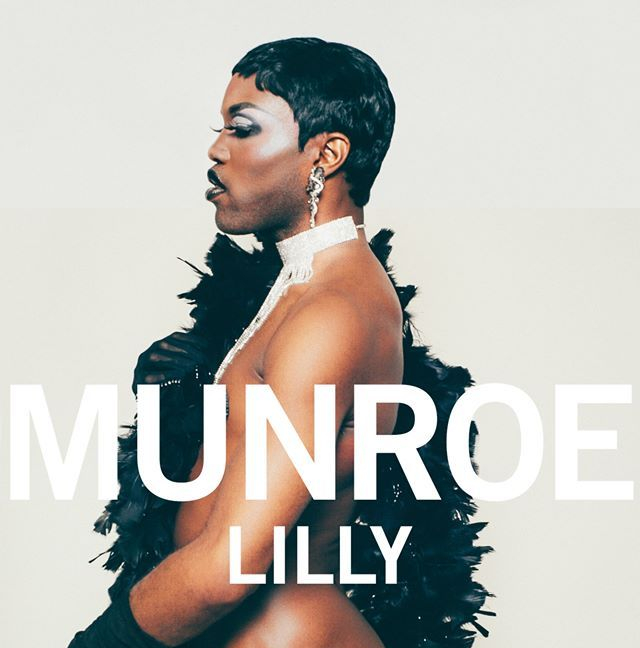
Wisely, Derrick escaped to the City. Of all the stellar stage performers from our graduating class, Derrick is one of the only ones who has stuck to his passion. Nowadays, you can find him performing burlesque in NYC as Munroe Lilly. (You can check out his more ravishing photos through that link. NSFW.) He creates characters and costumes and choreography, he dances and entertains—and, if you’re a judgmental passive-aggressive WASP who balks at the thought of a mostly nude black man in sequins and feathers and straps, I hope you take a step of faith to appreciate a beautiful person creating his art.
Part Two: Home Of The Braves
Suffice to say, my experience of black culture in Canandaigua was limited. Yet, through a variety of influences, I was intrigued. Schools near Rochester rightfully teach Douglass as a local hero. Tubman gets lip service, and Dr. King gets a fair shake (but not Malcolm). Hip hop dominated the pop radio stations and featured strongly/ironically behind my favorite comic book adaptations: Partners In Kryme’s ‘Turtle Power’ for Teenage Mutant Ninja Turtles, and Method Man’s ‘The Riddler’ for Batman Forever. I was in love with history class and gearing up for a career in teaching. Small doses of black literature passed my way: late in high school, The Bluest Eye, and maybe a couple short stories. Mostly, black voices appeared as characters in our required reading, not as authors of their own stories: Jim in Huck Finn, and Tom Robinson in To Kill A Mockingbird, and through diverse casts on television: GhostWriter, Family Matters, and a Saturday morning show that was probably daft and problematic, City Guys.
It was the 90s, and we called representation and inclusivity other names: ‘diversity’ and ‘multiculturalism’. Posters in the school cafeteria advertised milk with a crew of child actors so diverse you couldn’t cast them in Canandaigua. I remember mocking the posters during lunch with some enlightened white boys. “It’s so forced!”, and “No one likes milk that much.” The posters and the TV shows were a bit silly. Tokenism’s sin is rooted in its failures as a storytelling device: A) people are used for superficial reasons that may extend stereotypes, B) that superficiality limits the reader/viewer to a shallow reading, often without nuance and C) you’re still reading the (white) storyteller’s story, at heart. That said, if these narrow 90s attempts at representation and inclusion helped prod me toward black culture, then I’m grateful.
As a kid who wanted to be a teacher, I had lofty ideas about the power of education to heal and transform historic wounds like prejudice. Still do, in a way. At one time, I was close to positioning myself as a white savior. I entertained the idea of teaching in the inner city, like a colonial missionary. Go Teach for America. Go to Baltimore. They were recruiting anyone with a degree and a pulse. The trouble with imagining yourself a hero in any social realm is you haven’t got a clue about the real problems people are facing. When it comes time to help, you’re flailing. You’re a windmill trying to jog.
I came back to Canandaigua Academy as a substitute teacher. One day I was assigned to a history teacher’s class. It was his first year on the job; I don’t know if he’s still there. It was late in the school year. He was out grading papers, and I had to give busy work to his students. I noticed right away that a black girl in the center row was frustrated. She was making very little progress and looked exhausted. I think I asked if she was all right, and her response was quiet. A couple minutes later, I’m at the back of the room, and the class explodes. There are wads of paper on the floor. Two bullies in the front were harassing the girl; I only heard snippets. She stands up and yells something at them, then rips up her work and sits down. I don’t remember what I did next. I was in shock. I think I yelled at the class, something about unacceptable behavior. Everyone was blaming each other. The girl was crying. I didn’t know anyone’s names; I didn’t know who to hold responsible. I got them to a quiet ceasefire. At the end of class, I gently stopped her and asked what the boys had done. She said they called her a racial slur, that they’d been doing it for weeks, from the start of the year. She insisted she didn’t want more help, and left.
As a teacher, you don’t want to receive a negative note from a sub. It means unfinished business to follow up on. It could mean that you’re failing at your job. I left the teacher a lengthy, negative letter explaining what happened. Thing is, if I had been that teacher, I’m not sure my class would have been much better. I’m not positive I would’ve known about that girl’s trials, or cared enough to ask before an explosion.
Please don’t try to soothe me. Don’t tell me I’d be better than that. Your passive-aggressiveness isn’t as rich as mine.
Part Three: This Was Ostensibly About Books
Getting over prejudices in Upstate, NY is a long haul of shedding delusions and occasional enlightenment. After Canandaigua, I went to a similarly WASPy college. An education professor encouraged us to read Douglass for his ideas on the liberating power of reading, and Booker T. Washington, for his pedagogy. The professor was uber-conservative and didn’t assign DuBois, but I took that upon myself. Also, one day in class he said, ‘people accept that certain races are better at sports, but they will not accept that their brains may be different.’ I think we shot him down. Sometimes he liked to present challenging arguments to prompt discussion. I don’t know. He might have just been racist.
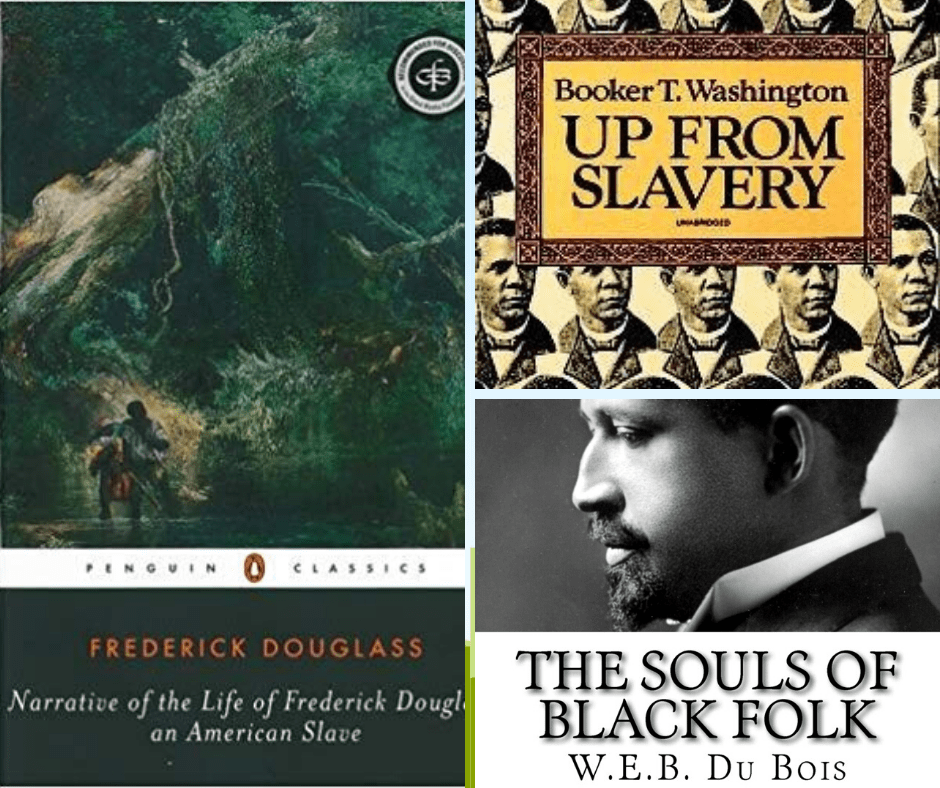
Anyways, I read those three books, Narrative of the Life of Frederick Douglass, An American Slave; Up From Slavery, and The Souls of Black Folk. As an educator, I believed that Washington and DuBois were reconcilable, that there was a need for both vocational training and the liberal arts in different cultures and communities. I marveled at Douglass’ power as a self-taught man, and his courage. Washington was an incredible leader. DuBois’ essays are sharp; of the three books, I would revisit his first, because it was tougher to grasp, and the last essay on spiritual songs is haunting. The essay pairs well with Douglass’ bold essay on being a Christian and an American: how can the two be reconciled when Americans do such terrible injustice?
I believe it’s my responsibility as a Christian American artist to try to understand and address the pain in our history. A big way I can do that is by reading, listening to, and watching stories by the people who lived it. I believe topical art has the power to heal or wound, and I’d like for mine to do more of the former. Books and learning are funny. I can’t tell you now, a dozen years after reading these books, exactly what prejudices they scrubbed, or how I was made a better person. I am sure there are more prejudices lurking within my psyche, maybe some you’ve identified through reading this essay. Reading’s not all self-improvement, mind you. As far as essays go, these three books are engaging and challenging. They are vital.
Epilogue
When I was living at home, recovering from my first psych ward hospitalization, my Mom found an improv show on American history to attend at the local college. It was a good escape, part sketch, part short-form. There was a joke I’ll never forget about rearranging the letters in Spiro Agnew’s name. (Grow a penis.) I went to the show not knowing that Derrick was performing. It was the first time I’d seen him in years.
Derrick was really good in the show, a strong support to two near-manic guys who hogged the stage. After the show, he was delighted to see me. I was embarrassed, because I was a depressive wreck, and nobody who’s supposed to be in college wants to be recognized in their hometown. Derrick said he was nervous, because he thought he didn’t perform well, and I tried really hard to tell him how good he was. I tried to cross the gaps in our relationship, to make up for all the ways I had categorized him instead of loving him as a friend. I wanted to fix my patronizing attitude, to know his trials, to be his strong support.
We became friends on Facebook, and that was the extent of our connection for a dozen years. I wish this story had a happier ending. I still live in Upstate, NY. I’m still growing, slowly, about the same rate it takes to freeze a lake, about the same rate it takes one blade of a giant windmill to go around. That’s me, Windmill Phil. I may be white and cold and immobile, but I’m sincerely trying to give power to all kinds of people, near and far.

P.S. Canandaigua is the ‘The Chosen Spot’. That’s from the Iroquois language. There’s an island in the middle of Canandaigua Lake, where the Native Americans hid from the colonials while their village was pillaged, their babies were slaughtered, their women were raped. I don’t think I’ve read any Native American literature since Elementary School. Now accepting recommendations.
(1),(2) quotes taken from an interview with Derrick, conducted by our friend Nyemade (IG: @thatafricanbutterfly).
 Phil Gross, Game Designer
Phil this is so good I don’t even know where to start! Thanks for sharing your thoughts. As one of those 10 black people you mentioned who grew up in that same little spot in upstate NY I appreciated hearing your viewpoint on how things were. Having left our area I was amazed at how many prejudices I had engraved in me just from our surroundings & media. Being black I feel like I no choice but to address them and have my eyes opened once I entered more diversified areas. I’m forever impressed and grateful when individuals like you make the effort to learn and understand more simply because you want to enlighten yourself. So many people get defensive about the unconscious biases and prejudices we all have. This stops them from being able to really address and correct the issue. I’m glad you took the time to write this. I hope more people take the time to have the same level of growth and awakening that you did. 🙂
LikeLike
Thank you, Nyemade. I love all the work you are doing online + for your community. I am honored to have known you. I hope that, if I ever have the platform for it (i.e. I get off my butt), you will let me interview you. Shine on.
LikeLiked by 1 person